What are Open-pollinated Variety (OPV) Seeds and Heirloom Seeds
Our Objective
Nature is Life is dedicated to providing African farmers with a holistic solution for crop nutrition and access to open-pollinated variety (OPV) and heirloom seeds. These seeds ensure that farmers can reproduce their own food for future generations. Currently, Africa faces a major challenge—the destruction of its traditional seed varieties, along with introduced food seeds that have been cultivated on the continent for centuries. This has led to a significant loss of farmers’ ability to reproduce food and the critical skills needed to improve and adapt seeds to an ever-changing climate. In the past, farmers naturally selected and preserved the best seeds, allowing them to adapt to shifts in climate, soil fertility, and pest resistance over generations.
Over time, farmers selectively harvested and preserved seeds with built-in resistance to local pests, insects, and diseases—these were known as heirloom OPV seeds. Through natural selection, farmers worldwide, who originally learned agriculture from Africa, improved their seeds’ yields and resilience. However, in the late 1960s and 1970s, Western corporations, motivated by a desire to control food production, introduced hybrid seeds under the pretence of higher productivity. Over time, these hybrids cross-pollinated with OPV seeds, transforming them into hybrids as well.
Governments across Africa encouraged farmers to adopt hybrid seeds, often without understanding the long-term consequences. While hybrid seeds initially increased yields by 10–15%, they required high amounts of fertilizers and pesticides because they were not naturally adapted to local soils, rainfall patterns, or pests. Additionally, hybrids did not reproduce true to the original parent plant, making farmers reliant on biotech companies for new seeds each season. As hybrids lost their ability to reproduce, African farmers became dependent on expensive seeds, synthetic fertilizers, and chemical pesticides—undermining their ability to sustainably produce food.
A more critical issue is that African farmers have lost their ability to develop and adapt their own seeds through natural selection. At Nature is Life, we believe that for humanity to thrive, we must restore this capability and eliminate dependency on Western biotech firms. Historically, Western nations have fostered dependency on debt, technology, and now hybrid seeds—keeping Africa underdeveloped. If African countries fail to meet the expectations of their former colonizers, control over seed supplies could be used to manipulate agricultural production and food security.
Zimbabwe has already faced the consequences of seed dependency. Between 2000 and 2024, during the illegal economic sanctions imposed on the country, Zimbabwe was deprived of essential agricultural inputs—including seeds, fertilizers, pesticides, and farming technology—after becoming reliant on hybrids produced by Western companies like Dow, DuPont, Syngenta, and LimaGrain. This experience serves as a warning for other African nations: losing seed sovereignty means losing control over food production and, ultimately, economic independence.
To counteract this, Nature is Life is committed to supplying African farmers with organic, OPV heirloom seeds—allowing them to grow food sustainably, save seeds for future planting, and pass them down as an inheritance. Unlike hybrids and GMOs, OPV seeds naturally adapt to their environment, freeing farmers from reliance on foreign seed suppliers. Additionally, the nutritional value of hybrid and GMO crops is significantly lower than that of traditional OPV seeds, often containing up to 80% less essential nutrients like zinc and iron.
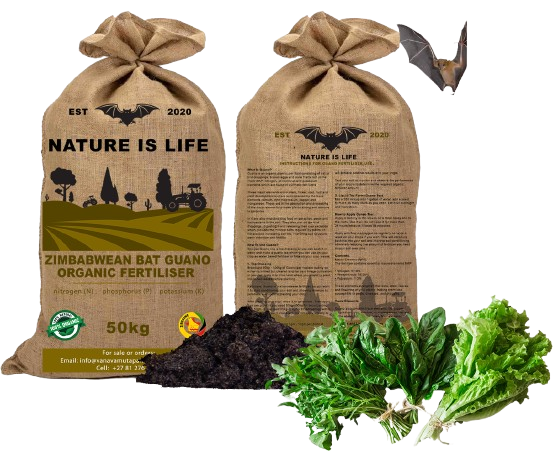
To support OPV seeds’ growth, we advocate for natural soil fertility solutions such as bat guano. Bat guano is a powerful, organic fertilizer rich in nitrogen, phosphorus, and potassium—key nutrients essential for healthy plant development. When used alongside OPV seeds, bat guano enhances soil fertility, boosts crop resilience, and improves overall yields without the need for synthetic chemical inputs. This sustainable approach not only revitalizes the soil but also ensures long-term food security for African farmers.
It is crucial to reintroduce OPV seeds and natural fertilizers like bat guano to empower African farmers. These time-tested, sustainable practices ensure long-term food security and agricultural independence. At Nature is Life, our mission is to equip African farmers with the seeds and knowledge necessary to protect their agricultural heritage, strengthen food security, and build a future free from external control. Join us in reclaiming Africa’s agricultural legacy and securing a sustainable future for generations to come.
1
One of the greatest threats facing African farmers today is the loss of their ability to create, produce, and adapt their own seeds. For generations, African farmers have not only fed their communities but also preserved biodiversity through traditional seed-saving practices. They naturally selected the best seeds to improve productivity, resilience, and nutrition. However, the rise of hybrid and genetically modified (GMO) seeds has fostered dependency on Western biotech companies. At Nature is Life, we believe that for humanity to flourish, we must reverse this incapacitation of seed producers and end reliance on external seed suppliers.
2
It is no secret that Western countries have historically kept Africa underdeveloped by fostering dependency—on debt, technology, and now hybrid seeds. The bigger concern is that if African countries do not meet the expectations of their former colonizers, their seed supply could be controlled, potentially being used as a tool to manipulate food production. Control over seeds translates to control over food systems, economies, and ultimately, the livelihoods of millions of Africans. True agricultural independence begins with seed sovereignty.
3
4
This is why Nature is Life was established—to ensure African farmers have access to organic, open-pollinated variety (OPV) heirloom seeds. These seeds allow farmers to grow their own food sustainably, save seeds for future planting, and pass them down as an inheritance to future generations. Unlike hybrids and GMOs, OPV seeds adapt naturally to the environment and eliminate forced dependence on foreign seed suppliers. By reclaiming control over our seeds, we reclaim control over our future.
5
The problem with hybrid and GMO seeds is not only that they do not reproduce, but also that they contain up to 80% less nutrition than original OPV seeds. Studies have shown that hybrid maize, for instance, contains significantly lower levels of essential nutrients like zinc and iron compared to traditional OPV varieties. This decline in nutritional value negatively impacts food security, human health, and the quality of crops being produced. By continuing to rely on hybrid and GMO seeds, we are not only weakening our seed sovereignty but also contributing to the rise of malnutrition in African communities.
6
As such, it is essential to reintroduce open-pollinated variety seeds that enable farmers to produce food that is not only reproductive but also medicinal and nutritious. These seeds, inherited and adapted over generations, ensure long-term food security and sustainable agriculture. At Nature is Life, our mission is to ensure that African farmers have the seeds and knowledge to protect their agricultural heritage, strengthen food security, and build a future free from external control. Join us in reclaiming Africa’s agricultural heritage. Together, we can build a future where African farmers thrive, free from external control.