What Are Open-Pollinated Variety (OPV) Seeds and Heirloom Seeds?
Open-pollinated variety (OPV) seeds and heirloom seeds are seeds that can be traced back to their origins and have been naturally improved through pollination and selection by farmers over generations. These seeds possess qualities that make them well-adapted to local conditions, preferences, and tastes.
OPV seeds result from natural reproduction through open pollination, where plants cross-pollinate freely, allowing farmers to select and harvest the best-performing seeds over time. This process leads to the gradual development of more resilient, high-quality seeds suited to specific environments.
Heirloom seeds are a type of OPV seed that carries historical and cultural significance. These seeds have been cultivated and passed down for over 10 generations within the same region, soil, and climate, making them highly adapted to their local environment. The key distinction between heirloom seeds and OPV seeds is that heirloom seeds have remained in continuous use within a specific community or family for centuries, ensuring their preservation and adaptation.
In short, heirloom seeds are legacy seeds that have been inherited and cultivated in the same region for generations, making them uniquely suited to their environment and highly valued for their historical importance.
What are Open-pollinated Variety (OPV) Seeds and Heirloom Seeds
Are Hybrid Seeds and GMOs More Productive Than Heirloom Seeds?
First of all, this question is somewhat odd. The reason being that when you consider the reproductive capabilities of seeds, it becomes clear that heirloom seeds, which have been able to reproduce for thousands of years, are more productive in the long term than hybrid or GMO seeds, which can only reproduce for a few seasons. The answer to this question is self-evident.
Any crop, animal, or living organism that has reproduced for 1,000,000 years, without ceasing from the beginning of time until today, and has the ability to continue evolving over those same 1,000,000 years into perpetuity, is obviously more productive than those that reproduce only over 1, 2, or 3 seasons. The fact is, hybrid seeds and GMOs, for example, a hybrid by nature is a crop that eventually loses its virility or ability to reproduce over time. GMOs are crops that produce over 1 season and generally have either a dominant genetic trait of termination or a recessive termination trait. Ultimately, both hybrids and GMOs will stop reproducing and lose the farmer’s ability to reproduce their food.
On the other hand, open-pollinated variety (OPV) seeds will produce in the first season and can be adapted by the farmer to increase production over time through natural selection and adaptation. They adjust to the soils, rainfall, climatic conditions, and environmental factors of the country where they are grown. OPV seeds cost nothing because farmers don’t have to buy new seeds every season—they can reuse the seeds from the previous year. Often, due to their adaptation to local soils and environment, and the fertility of the soils in which they grow, they can continue producing and even increase their output through natural selection, all without relying on fertilizers, chemicals, or other inputs that hybrids and GMOs depend on.
Seeds that can reproduce without requiring significant expenditure on inputs are considered more productive than seeds that need these inputs to survive. Additionally, OPV seeds consume less water and adapt to conditions like droughts, cold spells, and floods. OPV seeds have evolved over millions of years to survive natural disasters, making them more likely to thrive in extreme conditions compared to hybrid seeds. Therefore, OPV seeds are more productive in environments with drastic climatic changes than hybrids.
This is why, over the years, African farmers have been able to adapt millet, sorghum, cassava, and many other grasses and tubers to very dry and harsh climatic changes. Not only that, but millets and other African grains and grasses can flourish in exhausted soils without fertilizer and with minimal water. This is the result of the natural adaptation of these crops in semi-arid regions over millions of years. However, because African farmers have started using maize, which originates from South America and the tropical rainforest environment, this crop has not yet fully adapted to the African climate. Even though there are maize varieties like Hacklekie, Bloody Butcher, Kalahari, and others that are more adapted to dry conditions, they are still not fully suited to the climate change Africa is currently experiencing.
This shows that over time, African farmers have achieved this with OPV seeds in soils enriched with organic nutrition. The soils become more fertile over time, and the seeds become more adaptive, while hybrids produce less as they cannot reproduce. Soil fertility begins to decrease after a few seasons, leading to reduced yields.
It means that these seeds have been reproduced in the same environment, soils, and region for over 10 generations to the point where they have become fully adapted to the soil and climatic conditions of the particular region where they are found today. In other words, these are seeds that have been inherited by over 10 generations in the same place, ensuring they are well-adapted for continued reproduction.
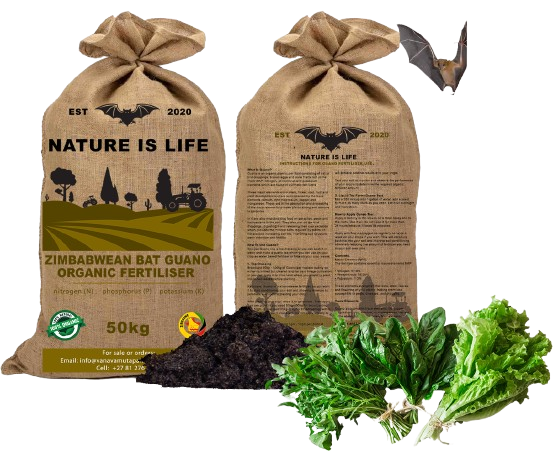
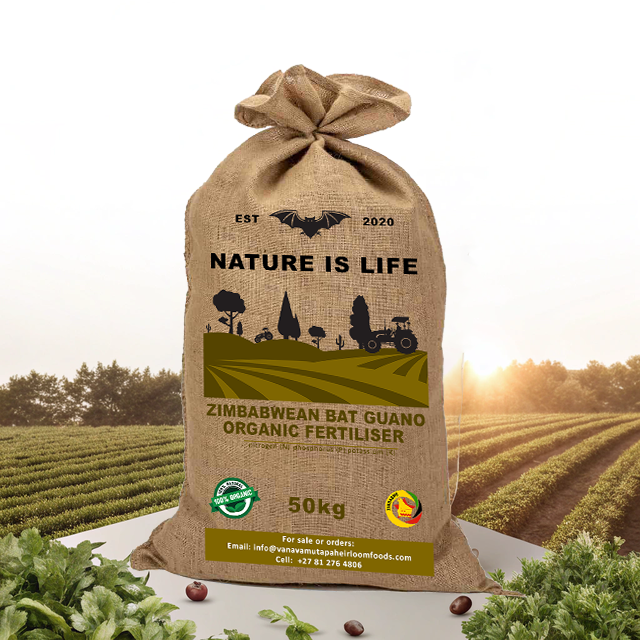
The beauty, intricacy, and sophistication of the world we live in demonstrate that it was designed by the greatest architect, creator, and designer. It is from this natural world that we take our blueprint for life. Life, the source of life, is organic, and it is based on nature. From this understanding, we have developed our brand. We’ve created “Nature is Life,” which includes organic manure extracted from nature, such as bat and seabird manure, to provide soil nutrition for our crops and sustain agriculture for the future.
1
The objective of Nature is Life is to ensure that we offer African farmers a holistic solution on the nutrition for their crops and also access to OPV, open-pollinated variety seeds, and heirloom seeds that reproduce to ensure that our farmers can reproduce their food going into the future. Currently, Africa is facing a scourge of the destruction of its traditional seeds alongside food seeds that have come onto the continent from other countries over the centuries. The problem with this has seen our farmers losing their ability to reproduce food and the skill and capacity to improve their seeds and adapt them to the ever-changing climate. In the past, farmers were able to grow their seeds and, through natural selection, pick the best seeds adapted to the changes that were happening to the climate, environment, and even the pests that feed on these crops.
2
3
Governments all across the continent encourage their farmers to replace their open-pollinated variety seeds with hybrids. However, many farmers didn’t realize that these hybrids, while increasing their yield by 10 to 15 percent in the short term, would also require high amounts of fertilizers and pesticides. This is because the hybrids were not adapted to the soils, fertility, rain patterns, or diseases of the environment. Additionally, farmers lost the ability to reproduce the food as the hybrids could not reproduce true to the original parent seeds. Over time, hybrids would stop reproducing, leading farmers to become dependent on biotech companies for hybrid seeds. The biggest threat to Africa’s farming is the inability of rural farmers to produce food, as they now have to repurchase expensive seeds, fertilizers, and pesticides to make them flourish in unfamiliar soils and manage pests that are not adapted to the African environment.
4
More critically, an even bigger threat is the fact that African farmers have lost their ability to create, produce seeds, adapt their seeds, and naturally select the best seeds to improve productivity over time. At Nature is Life, we believe that for humanity to continue to flourish, there is a need to reverse this incapacitation of our seed producers and the fostered dependency on Western biotech companies to produce seeds for us. It is no secret that Western countries have often kept Africa underdeveloped by fostering dependency on debt, technology, and now hybrid seeds. Therefore, it is clear that in the future, if African countries do not meet the expectations of their former colonizers, there is a great risk that Western countries will control Africa’s seed supply, potentially using it as a tool to manipulate agricultural production.
5
This is something that we’ve already seen in Zimbabwe, where during the illegal economic sanctions imposed on Zimbabwe between 2000 and 2024, when they were removed in March, Zimbabwe was deprived of seeds, fertilizer, pesticides, and farming technology after being forced to become dependent on the hybrids that were made by Western companies like Dow, DuPont, Syngenta, and LimaGrain. As Africans, we need to learn from this experience of Zimbabwe to ensure that our ability to produce the basic need of food will not be hindered by the destruction of our seeds that will force dependency on our former colonizer who may and will use seeds as a form of taking control of our resources and our economies.
6
It is for this reason that we, as Nature is Life, came into being to ensure that we can provide African farmers with a source for organic, open-pollinated variety heirloom seeds, which farmers can use to reproduce their food and also pass down these seeds as inheritance to their children. Another inherent problem with hybrid seeds and GMO seeds is not only the fact that they do not reproduce, but more critically, it is known that they can have up to more than 80% less nutrition than the original OPV seeds that nature created.
As such, it is important for us to reintroduce open-pollinated variety seeds that will enable our farmers to produce food that is not only reproductive but also medicinal and nutritious.
Benefits of Bat Guano
- Bat guano is organic, offering a natural solution to enhance soil fertility and agricultural productivity.
- It contains living organisms that digest and release micronutrients into the soil, benefiting plant growth.
- The living organisms and bacteria in the soil consume bat guano, releasing micronutrients, mineral salts, and macro/micronutrients gradually for plant absorption.
- Organic mineral salts released by bat guano attach to soil particles effectively, ensuring optimal plant nutrient absorption and preventing nutrient leaching.
- Bat guano promotes soil life and fertility, unlike synthetic fertilizers that may deplete soil nutrients over time.
-
Increased soil life and bacteria from bat guano enhance soil cohesion, water retention, and plant growth, contributing to sustainable agriculture practicesand reducing carbon emissions.
And this is done without producing additional carbon, as is done by petrochemical-based synthetic fertilizers. - Bat guano is nontoxic, unlike synthetic fertilizers, which pollute water sources, kill living bacteria and worms in the soil, and pollute the water table. According to a report by the Chinese government, South Africa has lost the use of 19.5% of its agricultural land due to the contamination and toxification of those soils by synthetic fertilizers and pesticides. Additionally, China has lost 15.5% of its water sources that have been contaminated by synthetic fertilizers and toxic pesticides. By using bat guano, nations in Africa can avoid the contamination of water sources and land by utilizing organic solutions that are non-pollutive and renewable.
- Bat guano is a renewable source of food nutrition
- Bat guano is a potent and very effective fertilizer that fortifies the strength of plants by providing macronutrients and micronutrients. It releases nutrients slowly, ensuring that plants receive the right amount without oversupply or leaching into water bodies. Being a natural product, bat guano decomposes slowly in the soil, releasing mineral nutrients gradually for plants to absorb naturally. Bat guano not only nourishes the soil but also enhances plant growth.
- The decaying process involves living organisms consuming the bat guano and taking it into the soil in a natural manner that enables the organisms to thrive. This process allows the crop to absorb trace elements, minerals, and microelements that aid in the absorption of micronutrients, resulting in stronger plants with robust roots, bark, and leaves. This strengthens the plant, making it more resistant to disease and less susceptible to pests. When bat guano is used alongside OPV and heirloom seeds, it completes the agroecological cycle of sustainable agricultural practice, leading to optimal results at a lower cost to produce food in Africa, where higher productivity per hectare is crucial due to the increasing world population.
- Synthetic fertilizers have been extensively used in some parts of Africa, leading to soil fertility depletion and acidity. Bat guano offers a solution to restore soil life and fertility in exhausted soils on the continent, enabling food production. Instead of farmers needing to use lime to reduce soil acidity, bat guano provides a simpler solution for restoring exhausted and acidic soils in Africa.